
Choosing the right business structure is one of the first decisions every entrepreneur must make.
Two of the most common options for small businesses are the Limited Liability Company (LLC) and the Sole Proprietorship.
Both structures are widely used by freelancers, consultants, and small business owners.
However, they differ in important areas such as legal protection, taxation, credibility, and long-term growth potential.
Some entrepreneurs choose a sole proprietorship because it is simple and inexpensive to start.
Others prefer an LLC because it offers personal liability protection and a more professional business structure.
Understanding the key differences between these two options can help you choose the right structure for your business.
What Is a Sole Proprietorship?

A sole proprietorship is the simplest form of business structure. In this setup, the business and the owner are legally the same entity.
There is no separate legal company created. The owner simply begins operating a business under their own name or under a registered business name.
Key Characteristics of a Sole Proprietorship
- Single owner – The business is owned and operated by one individual.
- Easy to start – In most cases, there is no formal state registration required.
- Low startup cost – Usually only basic permits or licenses are needed.
- Personal liability – The owner is personally responsible for business debts and legal issues.
- Simple taxes – Business income is reported on the owner’s personal tax return.
Many freelancers, bloggers, and small online sellers start their business as a sole proprietorship because it requires very little paperwork.
What Is an LLC?

A Limited Liability Company (LLC) is a legal business structure created by filing formation documents with a state government.
Unlike a sole proprietorship, an LLC separates the business from the owner. This means the business becomes its own legal entity.
Key Characteristics of an LLC
- Limited liability protection – Owners are usually not personally responsible for business debts or lawsuits.
- Separate legal entity – The business exists independently from its owners.
- Flexible ownership – An LLC can have one owner or multiple members.
- Pass-through taxation – Profits typically pass through to the owners’ personal tax returns.
- Professional credibility – Having “LLC” in a business name can increase trust with customers and partners.
Because of these advantages, many growing businesses prefer forming an LLC.
Key Differences Between LLC and Sole Proprietorship
Understanding the main differences can help you determine which structure fits your situation.

Comparison Table
| Feature | LLC | Sole Proprietorship |
|---|---|---|
| Legal Structure | Separate legal entity | Not separate from owner |
| Liability Protection | Yes | No |
| Setup Cost | $50 – $500 depending on state | Usually free |
| Tax Filing | Pass-through taxation | Personal income tax |
| Business Credibility | Higher | Lower |
| Ownership | One or multiple owners | Single owner |
| Growth Potential | Higher | Limited |
1. Liability Protection
Liability protection is one of the most important differences between these two business structures.
Sole Proprietorship
In a sole proprietorship, the owner is personally responsible for the business.
If the business faces lawsuits or debts, personal assets such as:
- Bank savings
- Personal property
- Vehicles
- Homes
may be used to cover those liabilities.
LLC
An LLC creates a legal separation between the owner and the business.
In most cases, this means the owner’s personal assets are protected if the business faces lawsuits or financial obligations.
This protection is one of the biggest reasons entrepreneurs choose to form an LLC.
2. Startup Costs
The cost of starting a business also differs between these two structures.
Sole Proprietorship Costs
Starting a sole proprietorship usually requires very little money.
Typical costs may include:
- Local business license
- Small permit fees
In many cases, the total cost ranges between $0 and $100.
LLC Formation Costs
Forming an LLC requires filing documents with the state.
Typical expenses include:
- State filing fee: $50 – $300
- Registered agent service (optional): $50 – $150 per year
- Operating agreement preparation
Although the cost is higher than a sole proprietorship, many business owners consider the liability protection worth the investment.
3. Tax Differences
Both structures have relatively simple tax systems, but there are some differences.
Sole Proprietorship Taxes
Income from the business is reported on the owner’s personal tax return.
The owner pays:
- Personal income tax
- Self employment tax
LLC Taxes
A single-member LLC is usually taxed the same way as a sole proprietorship by default.
However, LLCs offer additional flexibility because they can choose different tax structures, including:
- S Corporation taxation
- C Corporation taxation
This flexibility can provide tax advantages as the business grows.
4. Business Credibility
Your business structure can influence how customers and partners perceive your company.
Sole Proprietorship
Sole proprietorships may appear less formal because they are not registered as separate legal companies.
This may not matter for freelancers or small local services.
LLC
An LLC often appears more professional because it is a registered business entity.
Adding “LLC” to a business name can increase credibility with:
- Customers
- Vendors
- Banks
- Potential investors
5. Ease of Management
Both structures are relatively simple to manage, but sole proprietorships require less paperwork.
Sole Proprietorship
- Minimal administrative requirements
- No annual state filings in most cases
- Simple tax reporting
LLC
Depending on the state, LLCs may require:
- Annual reports
- Registered agent renewal
- Compliance filings
These requirements are usually manageable but do involve additional steps.
When a Sole Proprietorship May Be a Good Choice?
A sole proprietorship may be suitable in certain situations.
1. You want the easiest business setup
There is almost no paperwork involved in starting a sole proprietorship.
2. You are testing a business idea
Many entrepreneurs start small before committing to a more formal structure.
3. Your business has low risk
Freelancers or consultants with minimal legal risk may find this structure sufficient.
4. You want to avoid startup costs
Because there is no formal company registration, the cost is very low.
When an LLC May Be the Better Option?
An LLC can be the better choice for many entrepreneurs.
1. You want liability protection
This is the biggest benefit of the LLC structure.
2. You plan to grow the business
LLCs provide more flexibility for partnerships and expansion.
3. You want a more professional business image
Registered companies often appear more trustworthy to customers and investors.
4. You want tax flexibility
LLCs allow owners to choose different tax structures as the business grows.
Which Is Better: LLC or Sole Proprietorship?
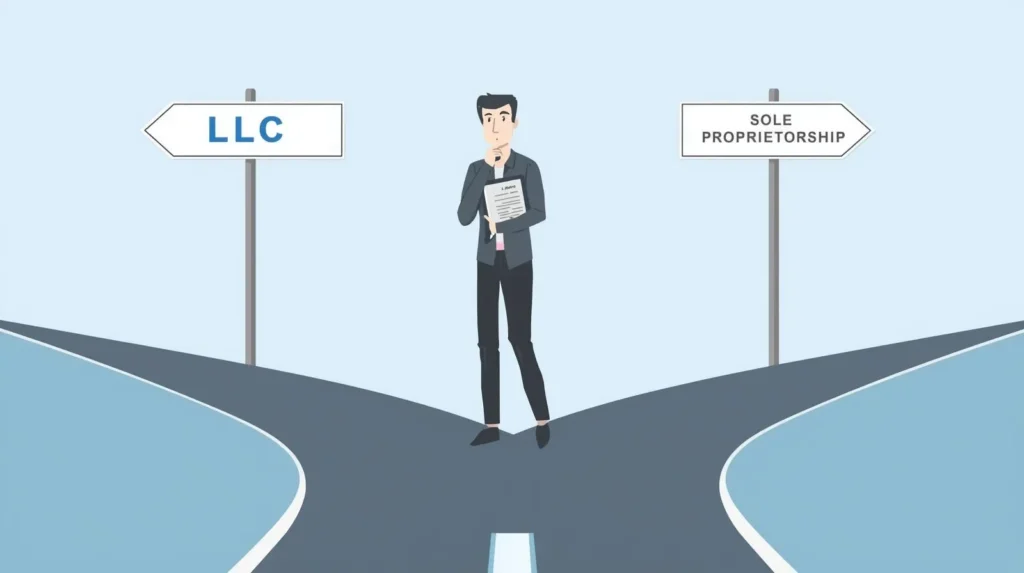
The better option depends on your business goals.
Choose a Sole Proprietorship if:
- You want the simplest business structure
- You are testing a small business idea
- Your business has very low legal risk
Choose an LLC if:
- You want personal liability protection
- You want to build a long term business
- You want a more professional business structure
For many entrepreneurs, starting with an LLC provides better protection and long term flexibility.
Final Thoughts
Both LLCs and sole proprietorships are common business structures used by entrepreneurs across the United States.
A sole proprietorship is easy and inexpensive to start, which makes it ideal for freelancers and small side businesses. However, it does not offer personal liability protection.
An LLC requires a small investment and a few extra steps to set up, but it provides important benefits such as legal protection, stronger credibility, and greater flexibility for future growth.
Before deciding which structure to choose, it is important to consider your business risks, long term plans, and financial goals.
Choosing the right structure from the beginning can make running and growing your business much easier.